
When people think about what makes home prices rise or fall, they often look at mortgage rates, inventory, or recent sales. But there is another powerful force working behind the scenes: the local job market.
After all, a home is more than a building—it is where people live, work, raise families, and build their futures. When a community has plenty of stable employment opportunities, more people may want to live there. That increased demand can influence home values.
Understanding the connection between employment trends and real estate prices can help buyers make smarter decisions and help sellers better understand what may be driving demand in their market.
Why Does the Job Market Matter to Real Estate?
Think of the local economy as the engine behind a community. When that engine is running smoothly, people generally feel more confident about earning an income, buying homes, and making long-term financial commitments.
A strong job market can contribute to:
More home buyers: When more people have stable jobs, more households may be ready to purchase a home.
Greater housing demand: New jobs can attract workers from other areas, increasing demand for homes.
Stronger buyer confidence: Employment stability can make buyers more comfortable taking on a mortgage.
Population growth: Areas adding jobs may attract new residents, creating additional demand for housing.
Potentially higher home values: When demand grows faster than available housing, prices may increase.
Peter Klein, Team Leader of Tress Homes, emphasizes the importance of looking beyond today's price when evaluating real estate. A home's value is connected not only to the property itself, but also to the community, opportunities, and demand surrounding it.
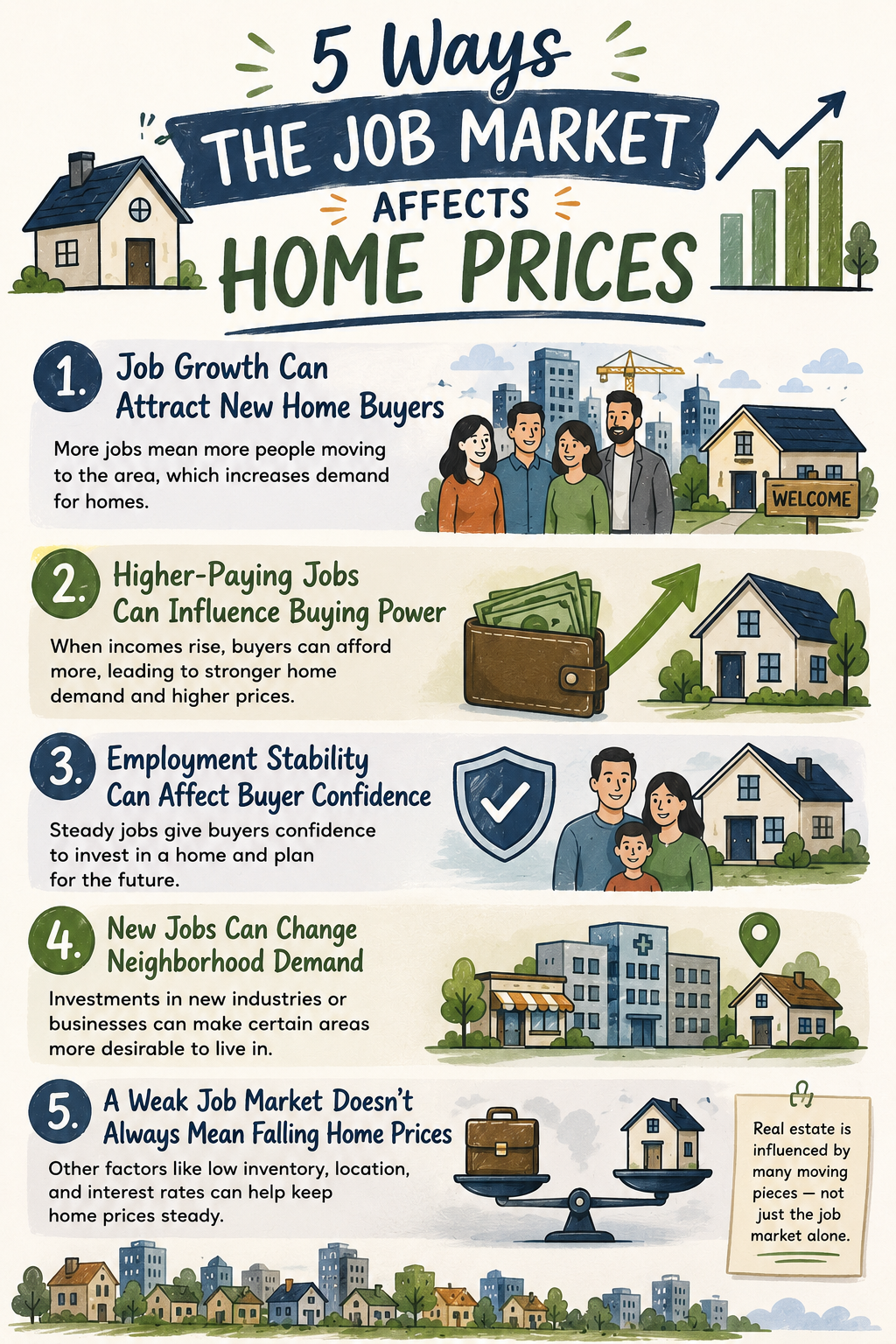
1. Job Growth Can Attract New Home Buyers
When businesses expand or new employers enter a community, they may bring new workers with them. Those workers need places to live, and some may eventually decide that buying a home makes more sense than renting.
This can create a ripple effect.
More jobs can lead to more residents. More residents can lead to greater housing demand. And greater demand can put upward pressure on home prices—especially when there aren't enough homes available.
For sellers, this can be an encouraging sign. For buyers, however, it may mean competition for desirable properties.
2. Higher-Paying Jobs Can Influence Buying Power
Not all employment growth affects housing in exactly the same way.
A community adding higher-paying jobs may see an increase in purchasing power. Buyers with stronger incomes may be able to afford higher-priced homes, compete more aggressively, or consider properties in neighborhoods that previously seemed out of reach.
However, buyers shouldn't assume that rising employment automatically means every home will become more expensive.
Mortgage rates, inventory, property taxes, school districts, amenities, and overall affordability still matter.
The job market is one piece of the puzzle—not the entire puzzle.
3. Employment Stability Can Affect Buyer Confidence
Buying a home is a major financial commitment. People are more likely to consider purchasing when they feel confident about their income and future employment.
On the other hand, layoffs, business closures, or a major employer leaving the area can make potential buyers more cautious.
This is why local employment stability can sometimes be just as important as the number of jobs being created.
A community with a diverse range of employers may also have an advantage because its economy isn't dependent on a single company or industry.
4. New Jobs Can Change Neighborhood Demand
A growing job market doesn't affect every neighborhood equally.
Homes located near employment centers, transportation options, shopping, restaurants, and other conveniences may become especially attractive to workers who want shorter commutes.
Imagine two similar homes. One requires a long commute, while the other is conveniently located near major employment opportunities and transportation. Even if the properties are similar, the second home may appeal to more buyers.
Location matters because time has value. For many buyers, saving 30 minutes on a daily commute can be just as meaningful as having an extra feature inside the home.
5. A Weak Job Market Doesn't Always Mean Falling Home Prices
This is one of the most important points for homeowners and buyers to understand.
A slowdown in employment doesn't automatically mean home prices will fall.
If housing inventory remains limited while demand stays relatively strong, prices may remain stable even when the job market becomes less active.
Similarly, a community can experience job growth without dramatic increases in home prices if there are plenty of homes available for buyers.
Real estate is influenced by multiple factors moving at the same time.
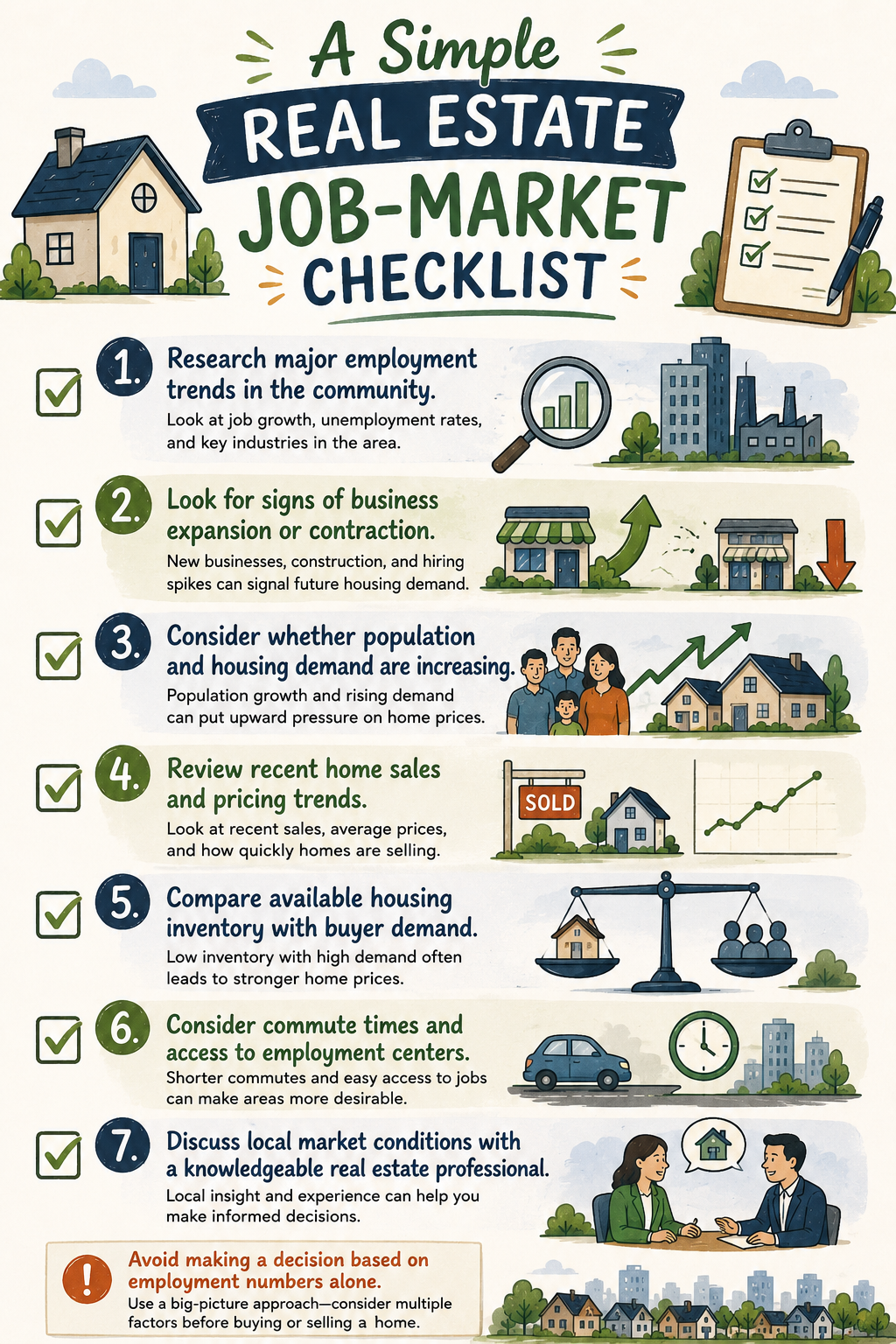
Before making a major real estate decision, take a step back and evaluate the bigger picture.
The Bottom Line
The local job market can have a meaningful impact on home prices, housing demand, buyer confidence, and long-term real estate trends. But it works alongside many other factors, including interest rates, inventory, location, affordability, and consumer confidence.
For buyers, understanding employment trends can provide valuable insight into where demand may be heading. For sellers, it can help explain why certain neighborhoods attract more attention than others.
Real estate is a little like a puzzle: the job market is one important piece, but you need to see how all the pieces fit together before making a decision.
If you're thinking about buying or selling, explore available properties at HomeOnward.com or contact Tress Homes at tresshomes@gmail.com for guidance. A knowledgeable real estate professional can help you look beyond today's market and understand the bigger picture behind your next move.