
You finally find a home you love. The location is right, the layout feels perfect, and you can already picture yourself living there. Then you hear the words every buyer hopes to avoid: “We have multiple offers.”
A bidding war can make even the most prepared homebuyer feel pressured to offer more than planned. But competing for a home doesn't automatically mean you need to overpay.
The key is to know your numbers, understand what makes an offer attractive, and recognize when it's smarter to walk away. With the right strategy and guidance from an experienced real estate professional, you can compete confidently without letting emotions take over.
Why Do Bidding Wars Happen?
A bidding war typically occurs when several buyers want the same property at the same time. This can happen when inventory is limited, a home is priced competitively, or the property has features that are especially desirable.
When multiple buyers submit offers, the seller may compare not only the purchase price but also financing, contingencies, closing timeline, and other terms.
Think of your offer as a package rather than simply a number. The highest offer isn't always the strongest offer.
As Peter Klein, Team Leader of Tress Homes, puts it:
“The goal isn't to win the bidding war at any cost. It's to make the strongest offer you're comfortable with while protecting your financial interests.”
That mindset can help you stay focused when competition heats up.
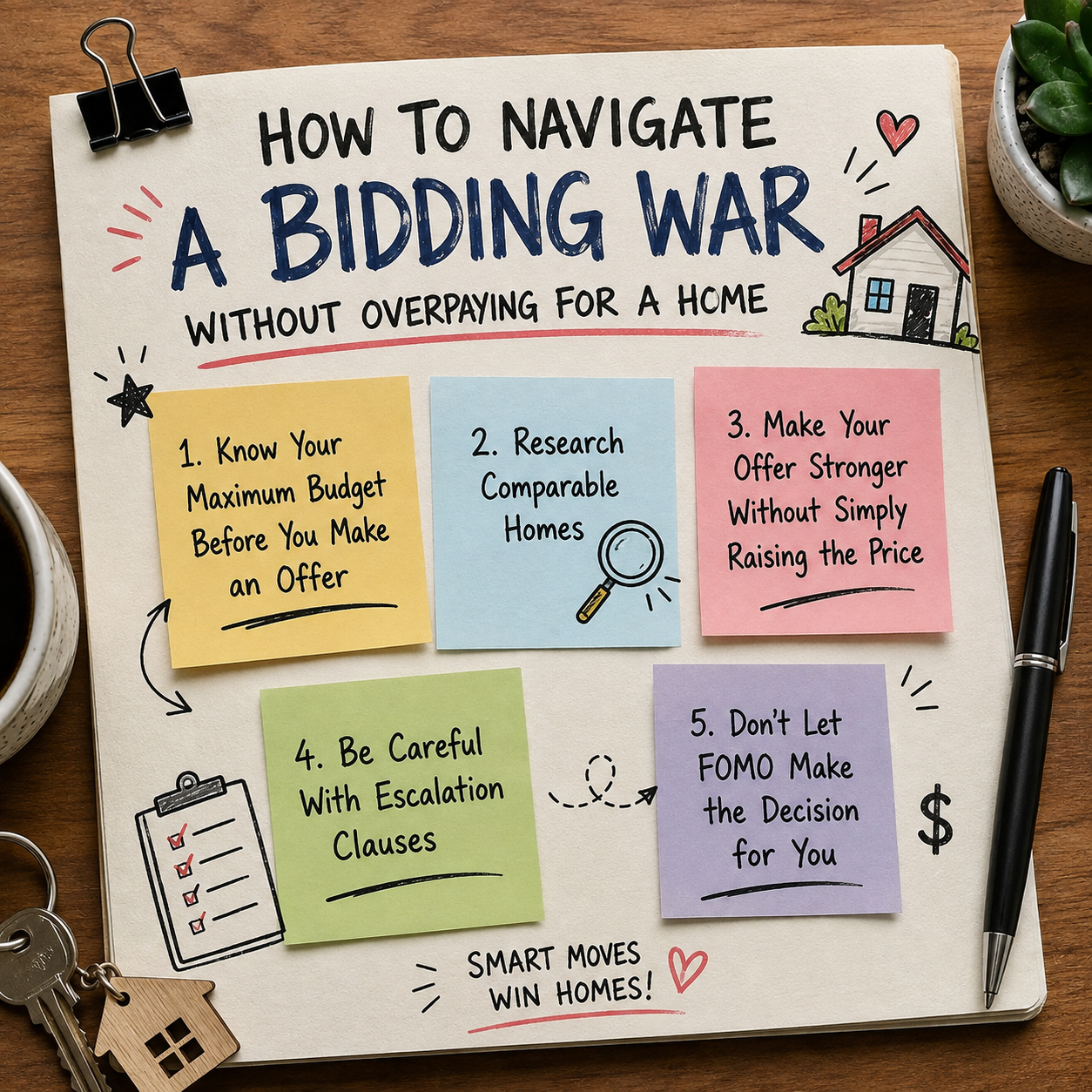
1. Know Your Maximum Budget Before You Make an Offer
The most important rule in a bidding war is simple: decide your limit before emotions enter the picture.
Before increasing your offer, consider:
Your mortgage pre-approval amount
Your available cash for the down payment and closing costs
Your estimated monthly payment
Property taxes and insurance
Potential repairs or improvements
Your emergency savings after closing
Your maximum offer should be based on what you can comfortably afford—not how badly you want the house.
A bidding war can feel like an auction, but your home isn't a prize you need to win at any price. If the numbers stop making sense, walking away may be the smartest financial decision.
2. Research Comparable Homes
Before deciding how much to offer, look at recently sold homes that are similar in size, condition, location, and features.
These comparable properties, often called “comps,” can help you understand what buyers have actually been paying—not just what sellers are asking.
Pay attention to:
Recent sale prices
Price per square foot
Number of bedrooms and bathrooms
Property condition
Lot size
Recent renovations
How long comparable homes stayed on the market
A home listed at $600,000 doesn't necessarily mean it's worth $600,000—or $650,000.
Your real estate agent can help you analyze the local market and determine whether a competitive offer is supported by recent sales.
3. Make Your Offer Stronger Without Simply Raising the Price
Price matters, but it isn't the only factor sellers consider.
Depending on your situation and local rules, you may be able to make your offer more appealing through other terms, such as:
A larger earnest money deposit
A flexible closing date
A mortgage pre-approval from a reputable lender
Fewer unnecessary contingencies
A reasonable inspection approach
Flexibility regarding the seller's preferred timeline
However, don't remove important protections simply because you're competing with other buyers.
A stronger offer should still be a smart offer.
Peter Klein emphasizes the importance of balancing competitiveness with caution:
“Buyers should never confuse being competitive with being careless. The best strategy is to strengthen the offer where it makes sense without giving up protections they genuinely need.”
4. Be Careful With Escalation Clauses
An escalation clause can allow your offer to increase automatically if another buyer submits a higher competing offer, up to a predetermined maximum.
For example, you might offer $600,000 with an escalation provision that increases your price by $5,000 over a competing offer, up to $625,000.
While this can be useful in certain situations, it isn't appropriate for every transaction.
Before using one, discuss the potential benefits and risks with your real estate agent. Make sure you understand exactly how the clause works and what documentation may be required.
5. Don't Let FOMO Make the Decision for You
Fear of missing out can be one of the biggest dangers in a bidding war.
You might think:
“If I don't increase my offer, someone else will get it.”
That's possible. But another possibility is that you stretch your finances too far just to win.
Ask yourself:
Is this home worth the additional amount based on comparable sales?
Will the higher payment still fit comfortably within my budget?
Am I comfortable with the home's condition?
Would I regret losing the home—or regret paying too much?
If another buyer wins, am I prepared to continue searching?
Sometimes the right decision is not the offer that wins. It's the offer you can live with comfortably for years to come.
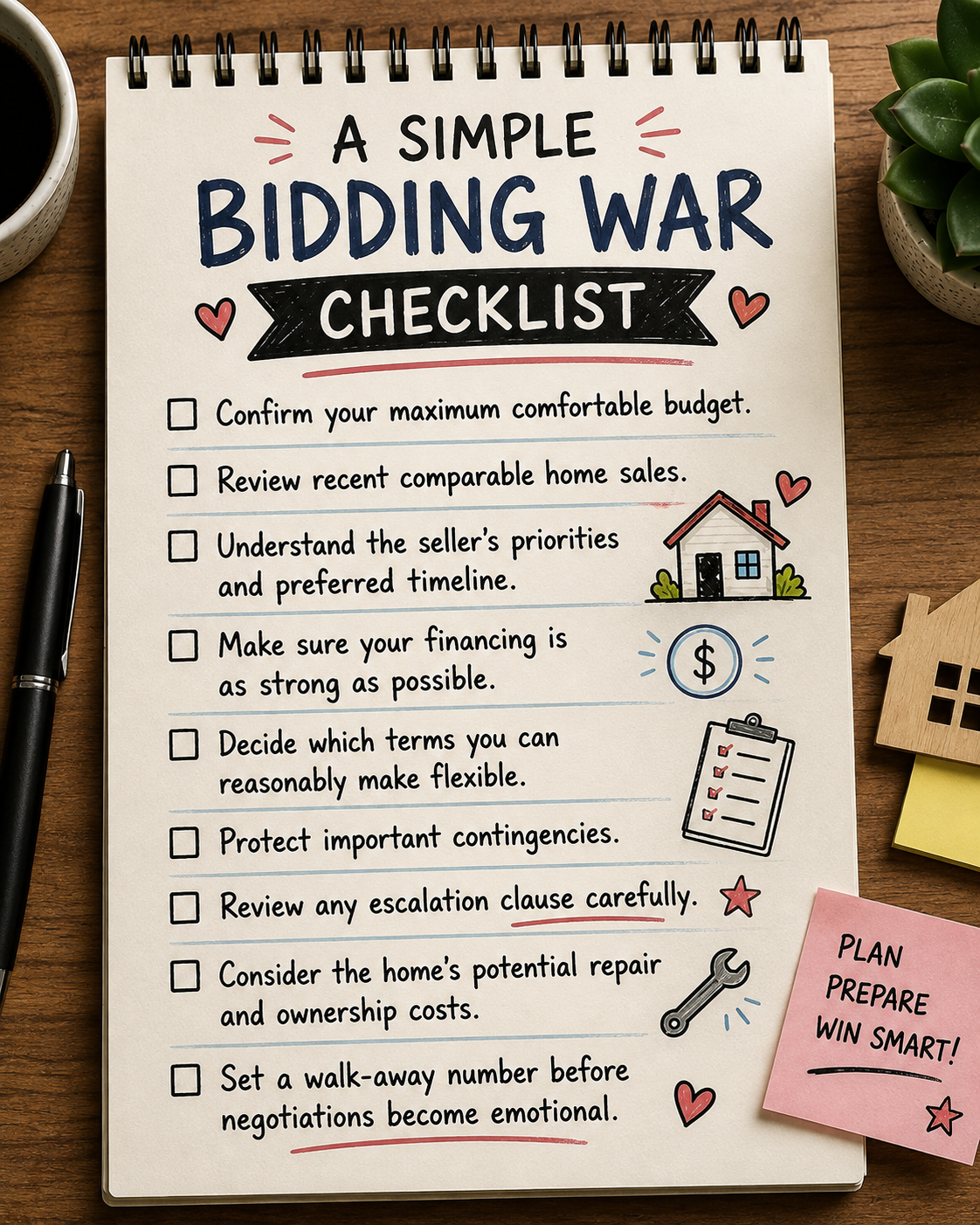
Before submitting or increasing an offer, review this checklist:
What If You Lose the Bidding War?
Losing a bidding war can be disappointing, especially when you've already imagined your life in the home. But it doesn't mean you've failed.
The right property may be the next one.
Continue monitoring new listings, stay prepared to make another offer, and use each experience to refine your strategy. Your agent can also help identify properties before competition becomes intense.
The real estate market is a little like fishing: you don't need to catch the first fish you see. You need to know what you're willing to keep—and when to let one go.
Final Thoughts: Compete With Confidence, Not Emotion
A bidding war doesn't have to turn your home search into a financial guessing game. The strongest buyers enter the process with a clear budget, research the market, understand their priorities, and know when to stop.
Remember, winning the house is only part of the goal. You also want to be happy with the price and terms after the excitement wears off.
If you're searching for your next home, explore available properties at HomeOnward.com. And if you're facing a multiple-offer situation and want help developing a strategy that fits your goals, contact Tress Homes at tresshomes@gmail.com.
The right offer isn't necessarily the biggest one. It's the one that puts you in the best position to buy the home you want without compromising your financial future.


